.NET Encryption
C Solutions specializes in .NET
encryption programming for
businesses.
Sometimes your
company is dealing with sensitive information which
needs to be handled in a secure manner. We have experience with
securing corporate data in a safe, fast, and efficient manner.
Need help building, or maintaining software with .NET
encryption?
Contact us now, so we can
help.
Encryptinator
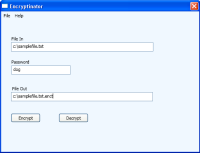
Do you have a need to encrypt files through a Windows
program? We have a program available just for you. It's called
Encryptinator.
Click here to learn more about Encryptinator. It uses AES/Rijndael
encryption to secure files from prying eyes.
AES/Rijndael
AES/Rijndael is the latest encryption standard approved by the US
government.
AES stands for Advanced Encryption Standard.
Here is a link to sample code, in .NET for implementing
AES/Rijndael.
Contact us if you need help on a program using AES/Rijndael. Our
experience in working with this encryption format in .NET goes all
the way back to the first version of .NET in 2002.
AES is a block cipher. Basically, what that means is, information is
encrypted in fixed blocks of data. With AES, these blocks range in
size between the choices of 128, 192 and 256 bits.
SHA1 / Hash Algorithms
SHA stand for 'Secure Hash Algorithm'. A hash is a function which,
when you put in a value, such as a password, a coded, seemingly
random value is created. The benefit of hash algorithms is you can
simply change one of the values of the inputted value to get an
output completely indistinguishable from the relative input and the generated random values 'cannot' be reversed
engineered. So, among others, the benefit is you can create, with simple
passwords, highly random password values.
SHA1 is just one of the hashing algorithms supported by .NET.
Here's a few of the other ones which are supported as well:
* MD5
* SHA1
* SHA256
* SHA385
* SHA512